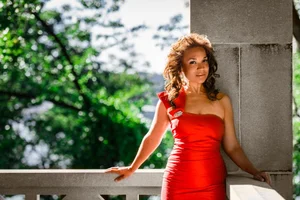
Q&A with Manna
Q. How did you get into opera?
A: In school and church choral groups from elementary on up, I was encouraged to sing in a classical style. I really didn't know or understand what that meant until high school when I was assigned my first opera aria, Voi lo sapete from 'Cavelleria Rusticana' by Pietro Mascagni for an All-City Outstanding Choral Student audition. I was adopted and raised by my great aunt who was the only other classical singer in my family. It goes without saying that finding out the little girl she chose as her daughter would become a classical singer sent her over the moon!! Prior to this, I had the same impressions of many who hear opera, "What is that screaming?" "What are they saying?" "And what's with all that extra drama??" However, there was something in me that couldn't turn away. Many mornings, my mother would often play various musical recordings (of my own and others) turning either the TV or record/CD player up way loud until I would wake up and come into her room. At the news I would be singing that first aria, she went to the library and rented a VHS of 'Turandot.' I remember harboring a great hatred for the heroine who makes victims of her suitors who don't guess her name. I thought, "Who does she think she IS??" Anyway, I digress...but once again, despite my outward disdain for the work, opera had me in its grip. It also didn't hurt that I ended up winning the the All City OCS award - first ever validation as an opera singer!
Q. There aren't many Black opera singers, right?
A. Wrong!!! There are LOTS of us in opera. Yes, there is still historically excluded groups remain underrepresented in opera, but more of us do appear onstage, but are largely excluded from decision-making authority. As a Black woman in this profession, I am turning my efforts to how I can be the change I want to see, starting with me. Still I RISE!!
Q. What is your range?
A: In classical music terms, I'm a Full Lyric Soprano. That means....uhhhhh....well, here's a "textbook" definition according to Wikipedia:
a type of operatic soprano that has a warm quality with a bright, full timbre which can be heard over an orchestra. The lyric soprano voice generally has a higher tessitura than a soubrette and usually plays ingenues and other sympathetic characters in opera. Lyric sopranos have a range from approximately middle C (C4) to "high D" (D6).[1] There is a tendency to divide lyric sopranos into two groups, light and full.
Again, whatever all that means...
Q. How long do you practice every day?
A: This definitely depends on the day but my practice ranges from a mere few minutes where I may not actually utter a single melodic sound to two hours of music making. In production, rehearsals range from 3 - 6 hours per day.
Q. Have you ever broken glass?
A. This is mostly a myth. It takes a nearly infinite set of scientific properties to make this happen, few of which involve anything in my range. So if I were to break glass, my clumsiness would be to blame. Not my high C's.
Q. Do you speak all the languages you sing in?
A. I sing in Italian, French, German, and English mostly. However, the only ones of these I speak is English. My favorite of this language assortment is German. It's a bit gruff and not terribly elegant, but I love the way you can bite on the language. What I do is translate, word for word, all of the text so that I know what I'm saying. There are various resources I use to do this, but all opera singers would agree that this is the most painstaking and time consuming part of learning music. As for the pronunciation, there is the International Phonetic Alphabet (IPA) that assigns specific word sounds to symbols which are applicable to all languages. Blah, blah, blah... Why do I feel like that makes me sound smart...HA!
Q. Where do you sing?
A. Mostly in New York venues, but generally - wherEVER the gig is. This includes productions, concerts, recitals, churches, etc. I am fortunate to have sung in renowned places like Carnegie Hall where I made my debut singing Cio-Cio San in Madama Butterfly. I have also sung abroad in Italy where I performed Fiordiligi in Mozart's Cosi fan Tutte. I’ve also been on tour and have sung on Broadway. Show me the CONNNNTRAAAAAACT!!
One of my favorite professional experiences was my first professional opera company contract where I premiered the role of Essie Robeson in a new opera composed by Adolphus Hailstork called, Robeson: The Opera. I am fortunate to reprise this role in the 2018-19 season.
Q. Do you compose music?
A: No, but I have collaboratively arranged a couple of pieces and continue to produce visual albums and have a libretto in the works. That said, I know my strengths. I'll leave the composing to the composers.
Q. Who are some of your favorite singers?
There are countless voices I admire, but the following voices just bring me to my knees. Of the opera world, past and present: Leontyne Price (OF COURSE), Anna Moffo, Angela Gheorghiu, Kathleen Battle, Anna Netrebko, Renata Scotto, and Dimitri Hvorostovsky, may he rest in peace. What is sometimes hard to admit is that I don’t listen to a lot of music in my spare time. It is silence that gives me the most inspiration!
Q. Do you have a closet full of gowns?
A. Yes. Well...definitely over a third full.
Q. Goals/Aspirations?
A. Earning my livelihood from full-time artistry has been my prayer for a very long time. I was fortunate to have day jobs that provided me some flexibility to pursue my singing career, but it is really difficult to have divided devotion to this craft. Now that I have departed from day job life, I am better able to do so exercise such devotion. I have opened myself up to opportunities beyond classical singing where I can express the full scope of talents I have to share. My ultimate goal is to be an influential artist as voice of change, healing and humanity.
Q. Are you famous?
A. One night I had a gig singing at a pretty high profile event where Sheryl Underwood was speaking. Afterwards, I was greeting my public and a little girl came up to me and asked in a most honest darling way, "Are you famous?" I said, "No, but now that you know me, I'm one step closer!" Her grandmother chimed in and said, "And God will give you the desires of your heart." I would like to be known as a voice that helped people discover dimensions of humanity in themselves and the world. In whatever art form I am presenting, I want to be an agent of awareness, healing, and change because I believe that. In the meantime, I just keep going FORWARD!